"We need more design founders". But they aren’t coming.
The call for more design founders by Y Combinator didn't help.

Y Combinator is the biggest and most successful startup accelerator in the world, with ~500 companies per year, with alumni like Airbnb, Stripe, Dropbox, DoorDash, Instacart, etc.
In May 2025, YC published a memo calling for more design founders. I looked into the data and checked if it helped them get more designers (and hopefully encouraged more designers to start companies).
I analysed 15 YC batches between 2020 and 2025 and how many of the participating founders are designers.
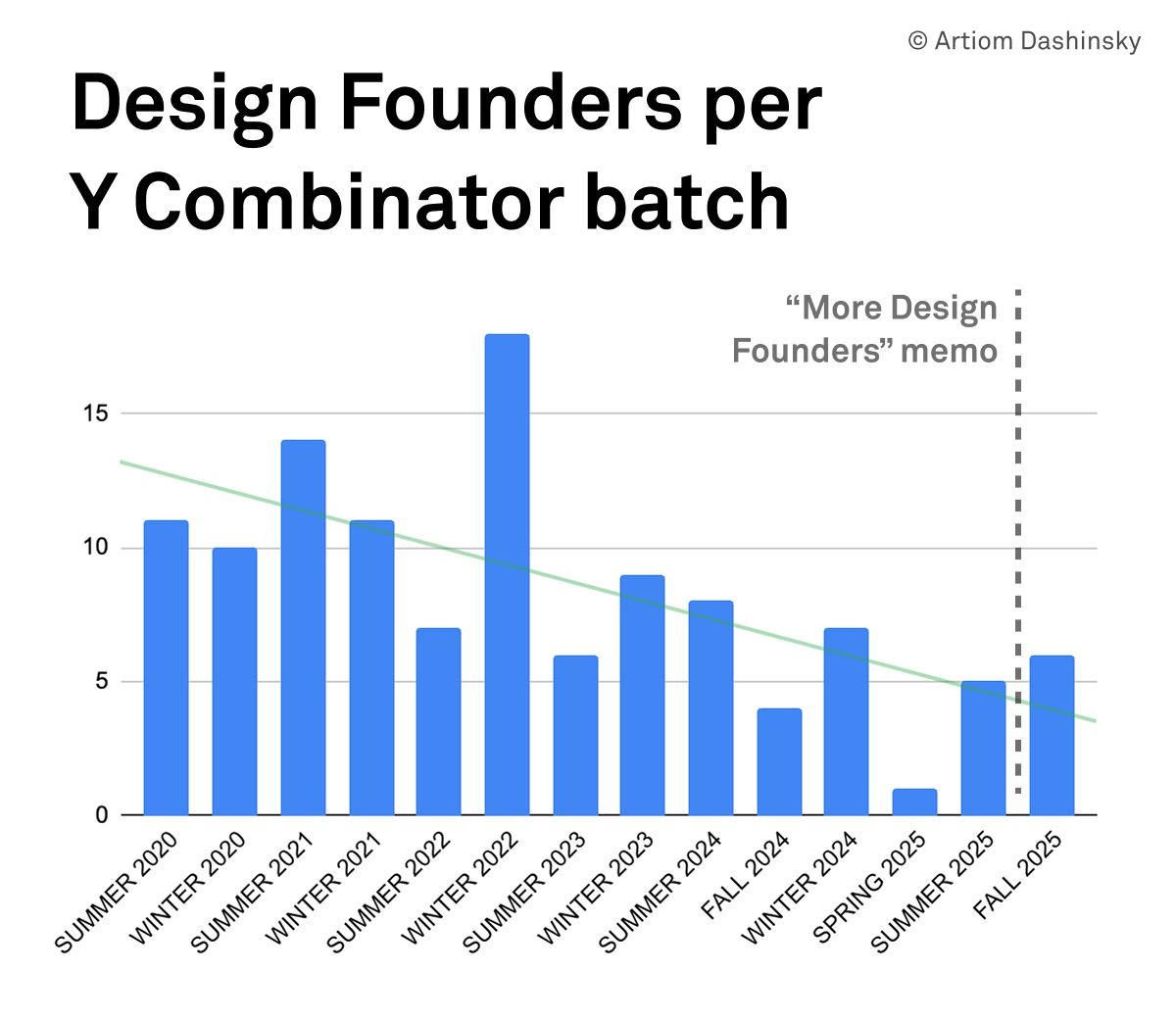
First of all, the call for more design founders hasn’t led to an increase (but to be fair, there was only one batch since the call).
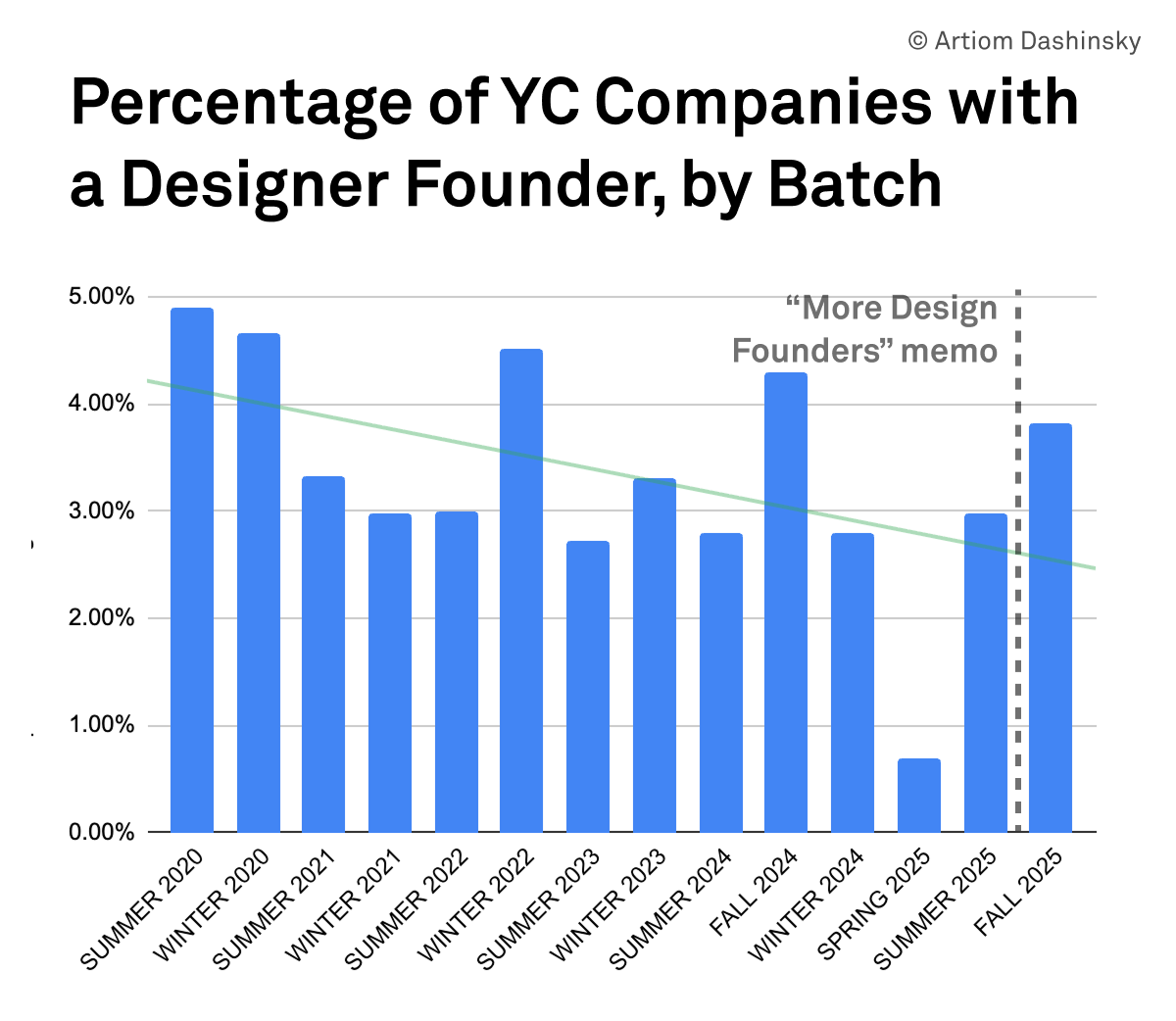
In addition, across all metrics between 2020 and 2025, the design participation is down:
Fewer companies have designer founders (both in absolute and relative numbers).
The total number of designer founders is trending down (despite a larger overall designer pool than in 2020).
In 2025, only 1.6% of founders at YC were designers. Assuming designers are more than 1.6% of the tech workforce (which they likely are), they are underrepresented.
You may think that YC is just one accelerator, and it’s not representative. You might be correct. But if the biggest and most successful startup accelerator in the world can’t get more design founders, who can?
Designers are often frustrated with how design is perceived and how organisations function. According to Noam Segal’s analysis, designers are the most burned-out role (which strongly correlates with quitting intentions).
So why don't more designers take the opportunity to make it their way, start their own company and finally show how it should be done?
I have my speculations, but before I publish them, I’d like to hear yours.
My two cents:
#1. Pure designers are in an awkward position right now. A lot of what they deliver can be matched by average AI output, which puts them in a tough spot. I think this is actually bad for the field. Work that should be done by humans, that benefits from human judgment and creativity, is now considered "good enough" when done by AI.
#2. When designers talk about delivering valuable work, they're usually judging it from a design perspective. The problem is, they often struggle to translate that into clear business value. Good design and business impact aren't always the same thing.
#3. I saw a diagram recently about where product design sits. Picture three circles: business, UI/UX design, and engineering. Product design lives in the overlap of all three. What that tells you is that design alone rarely decides whether a product succeeds. It's just one piece of a bigger puzzle.
#4. By the way, if you're interested in this topic, there's a publication called Design Founders. Really high quality stuff, highly recommend checking it out.
I’ve had a few failed startups as a design founder, and you learn so much each time you take something to market. Importantly, I’ve never been able to be a solo founder because I haven’t had the tools to do all of the things… until now. From people I’ve spoken with, designers with ambition and drive to be a founder aren’t boxing themselves into an identity of ‘designer’ in 2025.
Especially early days when your headcount is 3 or less, being a pure designer doesn’t move the needle as much as someone who can also do marketing and business development and UX Research, or someone who can be a PM + Designer + Front-End Engineer. You don’t have enough exposure or inputs from different areas of the business to decision as well as founders who have that multi-disciplinary exposure.
AI tooling is helping expand the landscape of what is possible - my latest efforts are all solo, thanks to AI tools that help people like me apply their earned knowledge while bridging knowledge gaps via technology.